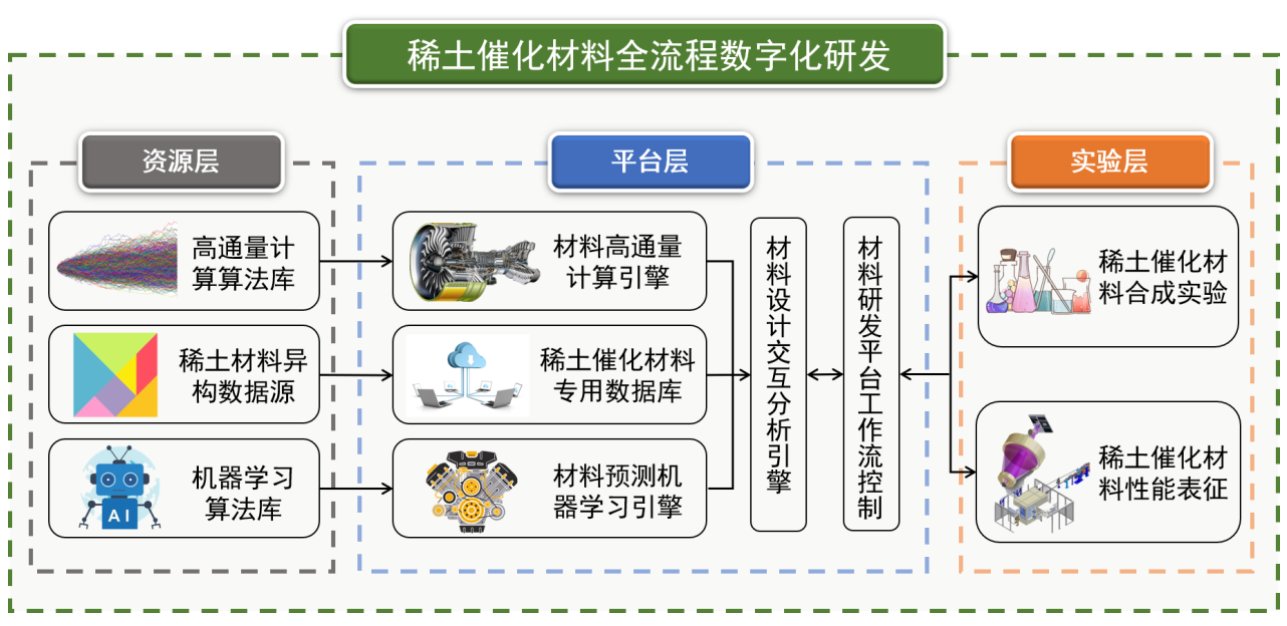
National Key R&D Program: Rare-earth catalysis knowledge graph and full-process digital R&D platform
Sep 2021–Aug 2024 · Subproject assistant
- Led construction of the database and materials knowledge graph, participating throughout the project from proposal to acceptance and ensuring scheduled delivery reviews.
- Designed and built a multimodal materials database at the million-record scale with 46,701 synthesis conditions, integrating heterogeneous data.
- Applied the knowledge graph to synthesis-condition recommendation and knowledge discovery to support intelligent materials R&D workflows.
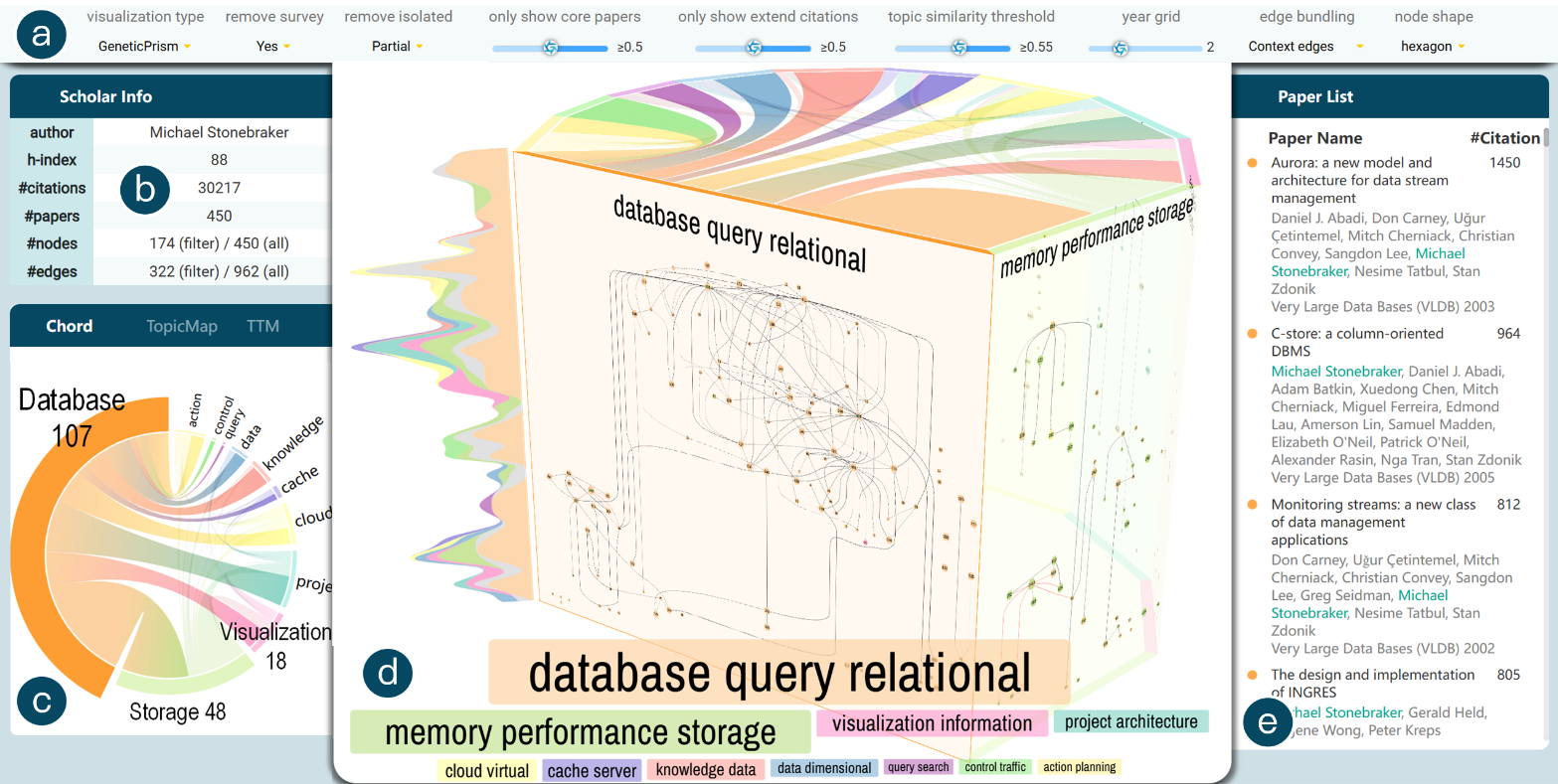
GeneticFlow V2.0 · Large-scale scholarly literature visualization system
Sep 2023–Sep 2025 · Algorithm research, architecture design, software development
- Led development of a multidimensional visualization system for million-scale scholarly literature, designing an integrated graph-layout and visual-interaction solution.
- Compiled Graphviz C++ sources into browser-side layout components, connecting graph-layout computation with front-end interaction through independent full-stack development and operations.
- The system has served 110,419 users worldwide, supported 540,440 visits, and received software copyright registration. ACM Fellow Ion Stoica commented: "This is interesting, especially the visualization."
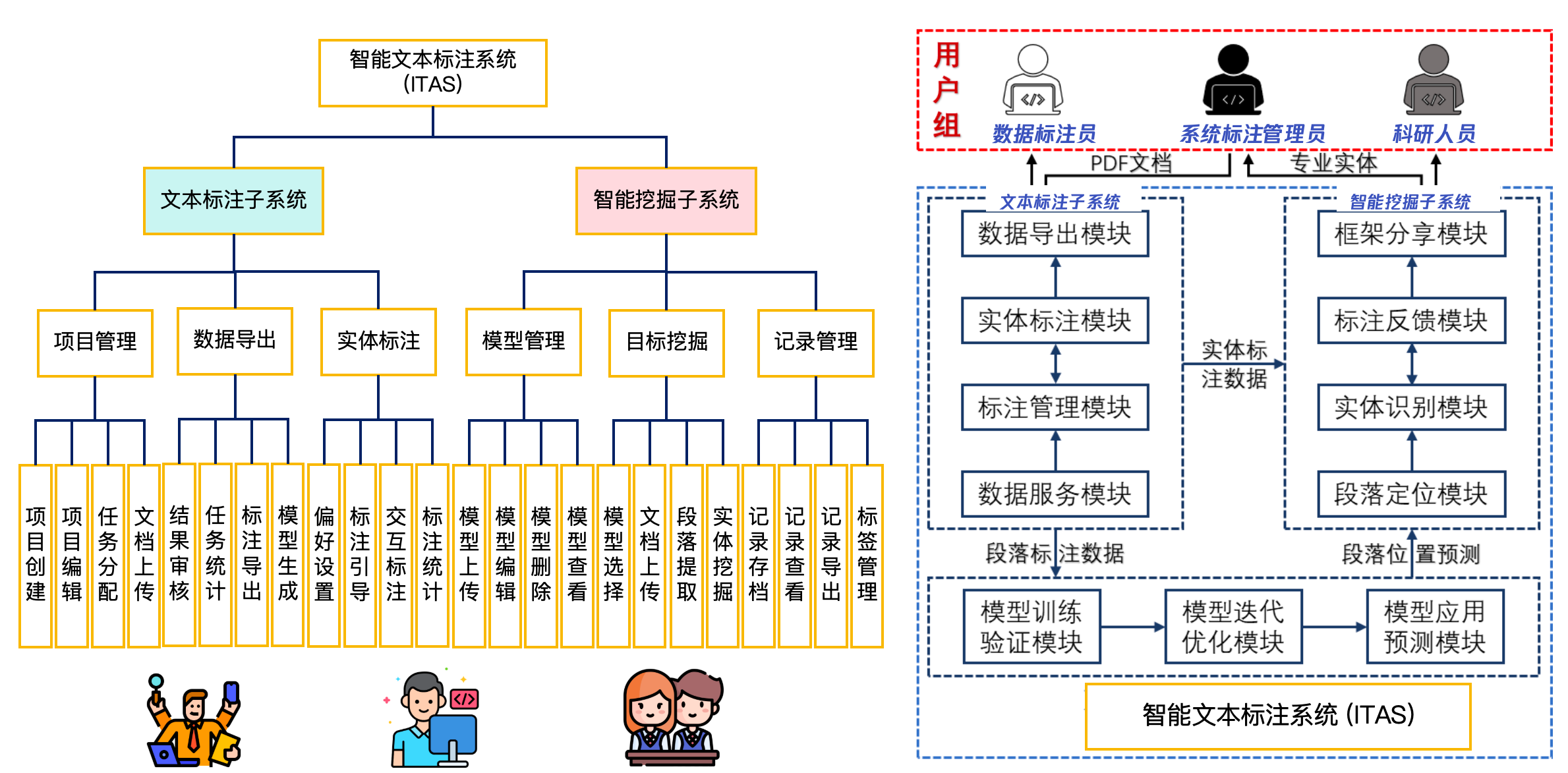
Multi-domain intelligent text annotation and information extraction system for scientific literature
Mar 2024–Jan 2025 · Product manager, software developer
- Mapped the scientific-literature knowledge-production chain and designed an end-to-end flow from document processing through annotation and review to intelligent mining and structured export, defining configurable annotation and mining subsystems and coordinating cross-module delivery.
- The system supports batch PDF upload, paragraph and entity-annotation review, LLM model and extraction-parameter configuration, and storage or export of annotation data and extraction results.
- Applied in MaterialBrain research, a BM25-retrieved few-shot synthesis-condition extraction pipeline achieved macro-F1 0.94 across three MOF datasets, a 22.1% improvement over the zero-shot baseline at 0.77; on MOF framework-density inference, it improved 32.9% over zero-shot.
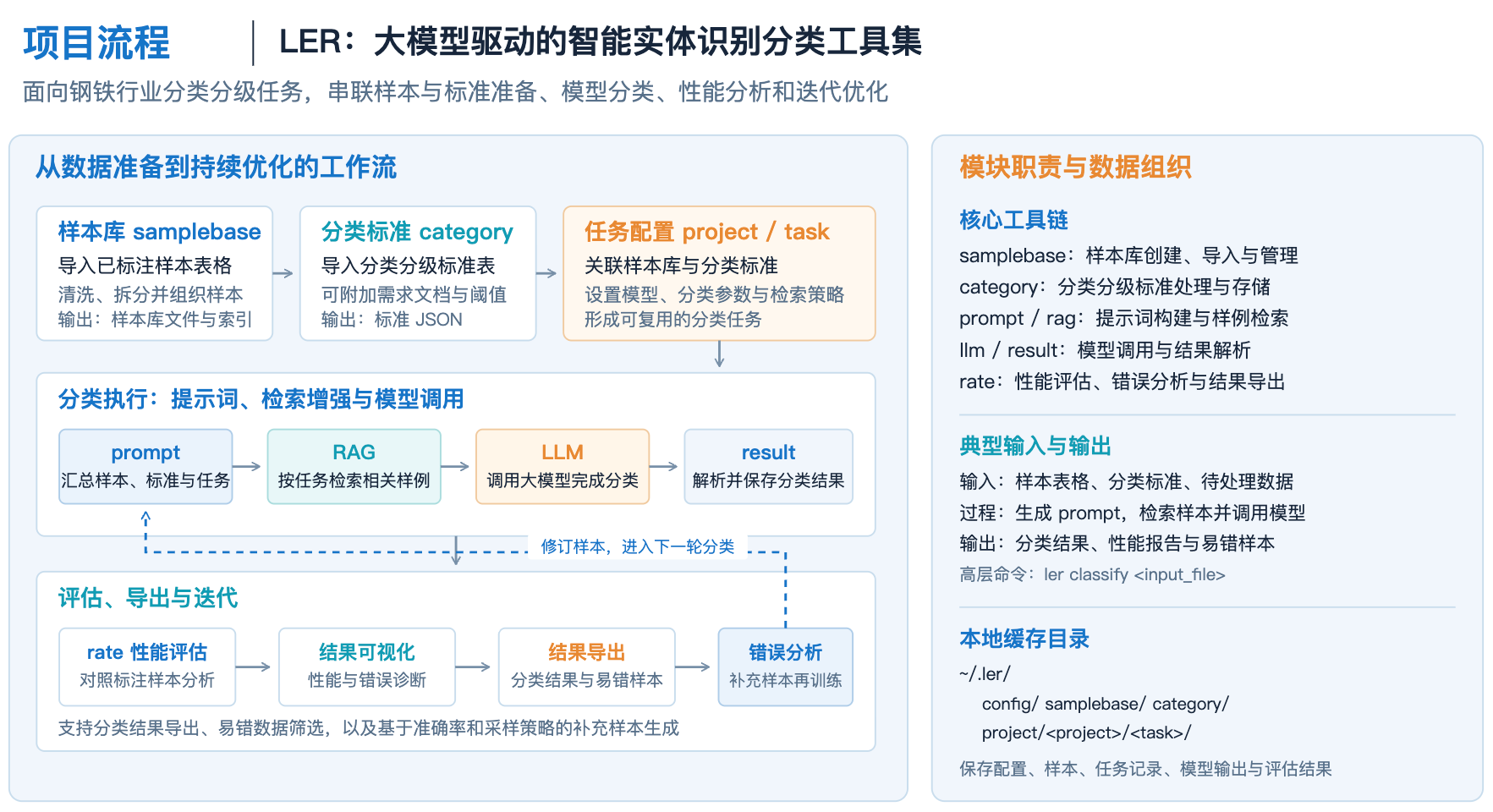
University–industry collaboration project: Research-agent-based data classification
2024.12–2025.05 · Architecture design, software development
- Led development of LLM-based entity-recognition tools and built a RAG-driven data-classification and grading system for automated sensitive-data annotation and dynamic refinement.
- The system has five core modules: prompt generation, model interfaces, RAG retrieval augmentation, result processing, and performance evaluation, connected through an end-to-end classify workflow.
- Applied across steel production, education, and other domains; supports sample-library, classification-standard, project, task, and environment management, with more than 100,000 records in the pending-classification database. The team was recognized among Beihang University’s Top 10 Outstanding Teams in Artificial Intelligence.
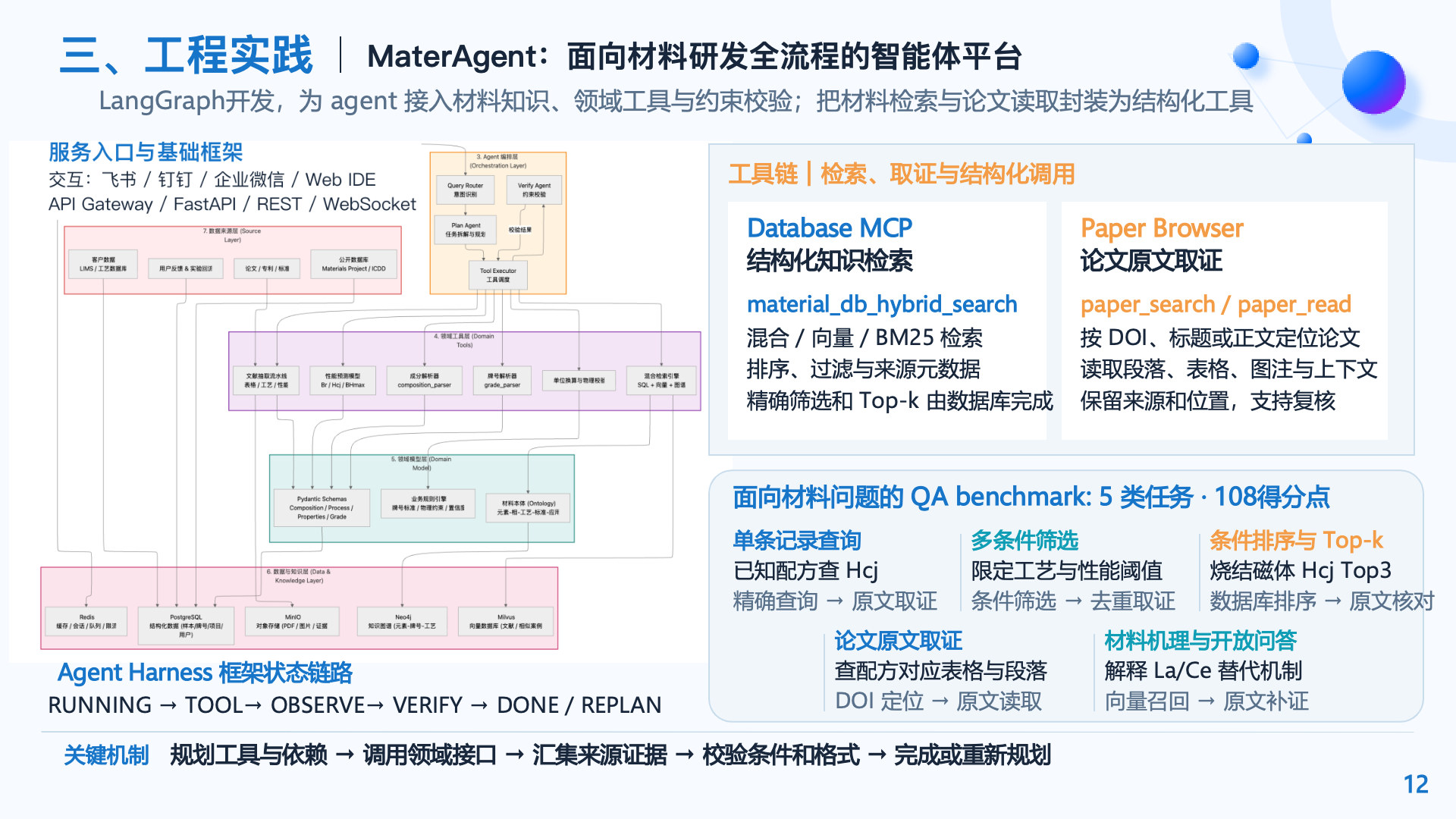
MaterAgent · Agent platform for end-to-end materials R&D
Jan 2026–Present · Architecture design, software development · New Material Intelligence / MaterBrain
- Developed a LangGraph-based Agent Harness with an Agent Loop for task planning, tool execution, observation, answer verification, and iteration; extended runtime, session-state management, and tool registration and discovery into a unified execution framework for literature research, database analysis, property prediction, and formulation design.
- Designed and developed MCP tools: Paper Browser (keyword paper search and chapter, paragraph, and table evidence retrieval); Database (BM25 and dense retrieval with structured filtering and ranking, returning retrieval scores and metadata); also developed NL2SQL, property-prediction, and formulation-optimization tools.
- Built a materials QA benchmark covering five task classes—constrained filtering and ranking, process summarization, paper evidence retrieval, and mechanism analysis—with 108 scoring points and a 99.08 score.